I-VE_SPACE by Secrecy One Ltd
I-VE_SPACE by Secrecy One Ltd dates back to 2019. This was when the Intuition Validation Engine (originally I’VE) was first formulated and placed online. The video at the top of this page contains the full formulation. You can also download this first PDF, including the formulation itself, by clicking through here. The video, meantime, is here.
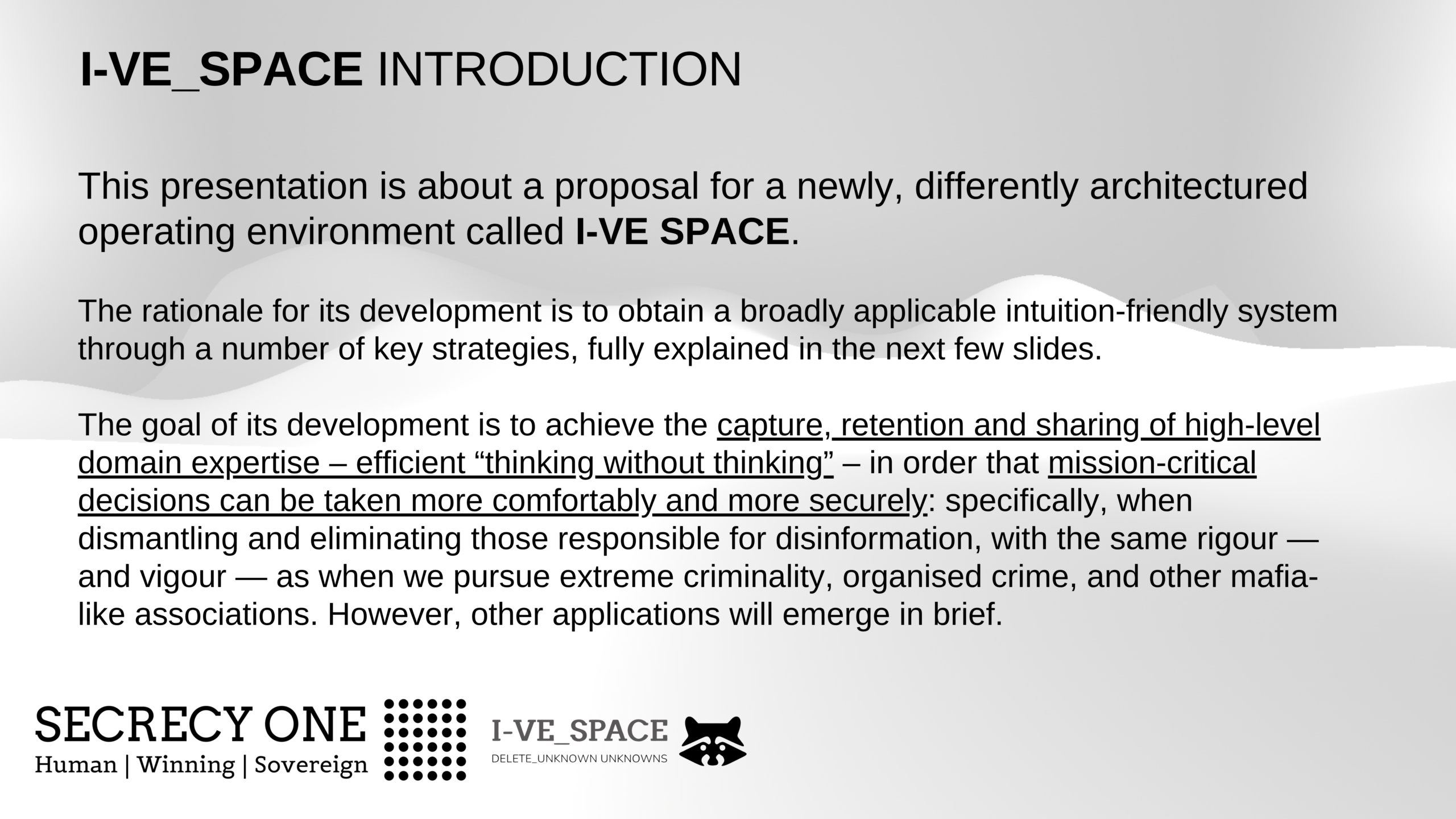
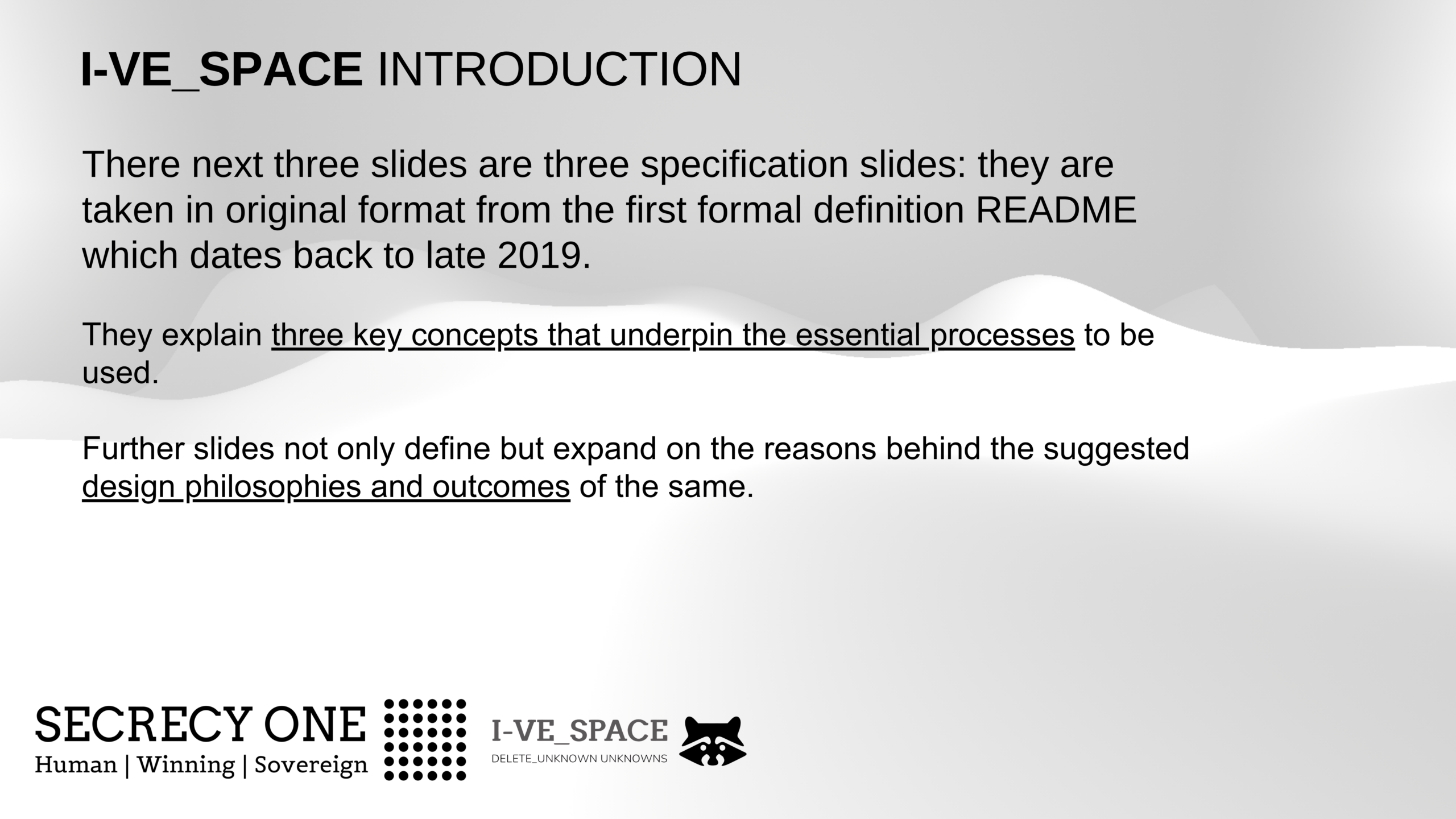
An executive summary with three key slides apart from I-VE itself can be seen immediately below.
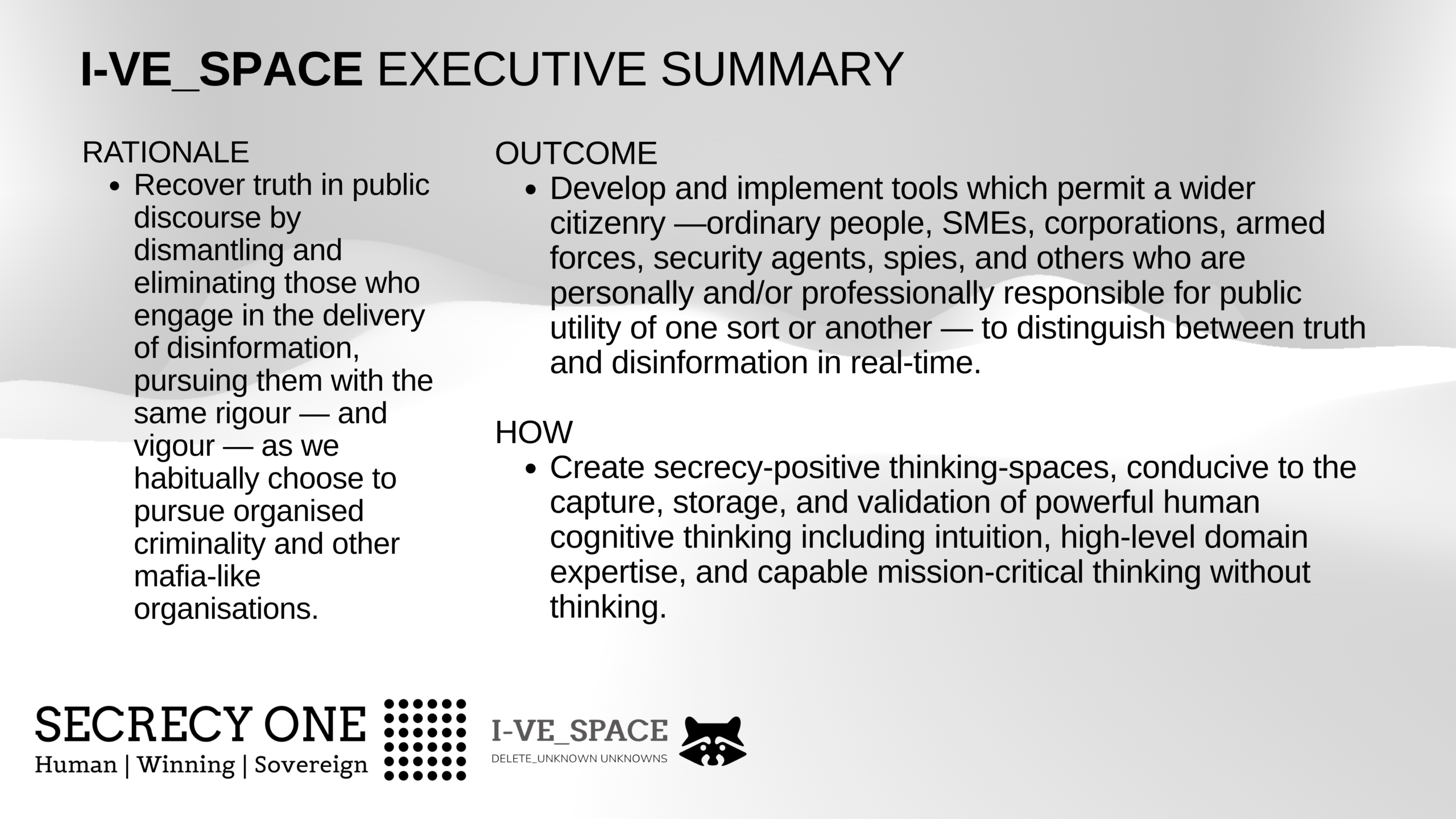
The primary goal of this new software architecture was to return us to the creative times of Steve Jobs and so many people like him in early startup, times which in the second video on this page continue to be enjoyed by Nordic countries such as Sweden: something the video that follows will evidence with data on startup business and activity in these countries.
But first, what exactly is the state that people like Jobs enjoyed and the rest of us no longer do? Well. That of secrecy: just this. A state analogous to pencil & paper levels of secrecy. Nothing strange or fierce about using pencil & paper. But when we suggest the same for digital workplaces, society — that is, our governments, as well as their agencies and institutions — encourage us to believe that when we have something that needs hiding it can only be for nefarious reasons. And that we lose nothing when we give up our secrecy.
We’re arguing a different line here. Extreme criminality, terrorism, cognitive terrorism on society, and similar, all already have secret places to think up their horrors in private before fully releasing them on their terrifying colleagues for evaluation and implementation. Our own surveillance architectures, meantime, involving admins (whether people or machines) who oversee users, and users who never see admins, lead to two considerable downsides of the very worst:
- A single vector into a system, vulnerable to attacks on all the users under the same.
- An inhibitor of free thought, where — knowing we are being watched — we find ourselves automatically censoring what we know is not ready for sharing, primarily because we know we are being permanently surveilled by our own side, never mind by our enemies.
Because of this process of self-censorship, we find our lines of thought cut through to the extent that we never go beyond the safe-to-reveal: safe in the context of a brutally imposed, technologically architectured groupthink. Instead of a hundred steps to the best solutions we get used to agreement after ten.
This is what we want to re-engineer. Not as a good-to-have either. As a need-to-have. We are already way behind our enemies.
The video that follows, then, lays out our rationale for all this, after eight years and maybe more of imagining why, what, how, and who really needs it. And who needs it? Professionals in policing and law-enforcement, security and espionage, the military in multiple battlefield domains, and others who serve to protect our democracies. Protecting whom in those democracies? Citizens, SMEs, and corporates, alongside our friends and families during simple leisure time and even whilst in living-rooms.
The question remains how. Nine years after I posed a doctrinal solution in my Criminal Justice MA — https://niokvinnor.com/2529/sin — the question remains how. The solution I now firmly feel lies in the analogous influences of Total Defence which Sweden and other countries have been promoting institutionally for quite a while.
The essence of Total Defence? Whilst the military must fight battles, they cannot continue to do so if the people and countries they are fighting battles on behalf of are not supported into being ready to fight, long-term, the wars in question, including hybrid and asymmetrical on entire societies.
It will involve the need to fashion and engineer a brand-new social compact for many nation-states. But we have to accept governments by themselves cannot protect everyone if everyone doesn’t take part in protecting everyone too.
The mission then? Secrecy-positive sovereign democracies for the long-haul. Nothing less than this.
More citizen- and government-friendly technologies, at the service of “total defence” doctrines
Click through to: Verify Home | For Everyone Who Cares About Work, Family & Friends
Click through to: Verify Plus | For CISO Change Makers Who Secure Hybrid IT
Click through to: VERIFY AWAY | FIGHT BACK AGAINST COGNITIVE ATTACK
Our Verify solutions? We want to take this one on the chin. We have chosen to build tools and software configurations that are both citizen- and government-friendly, legal, and compliant for the foreseeable. They are also cost-effective to use by everyone. And all under the umbrella of the Nordic concept of “total defence”.
Mission: “Total defence: Building armed forces that fight battles and societies that fight wars.” | Methodology: “Some people sell secrets. We sell secrecy.”
Mil Williams, Founder/CEO of Secrecy One Ltd | mil@secrecy.one