
Two Cases of Cyber and Digital Blackmail
This is a composite video made of two different ones, delivered just about a year apart.
The first was produced for an unsuccessful attempt to pitch at Mashup Malmö 2025.
The second was done in the early summer of 2026 for our new security startup — the subject of this website: Secrecy One Ltd.
Here, we’re interested in all kinds of criminality, alongside helping citizens guarantee their own digital and online wellbeing and related livelihoods much more effectively, and in much more state-empowering ways.
The first section shows just how hard it is to find accurate data on cybercrime and cyberwarfare: not states to states, or criminals to criminals, but both when bad actors on citizens just like and me, and how much exactly such attacks might cost us.
It’s almost as if our societies don’t care too much about the micro-effect on people’s savings, ordinary livelihoods, and small, but nevertheless singular, lives. Plenty of information out there on how it all works at the macro-level: county boundaries, international organised crime, etc. Drug traffickers galore, to be honest. But not how it feels to be attacked in your own living-room, via your own mobile phone.
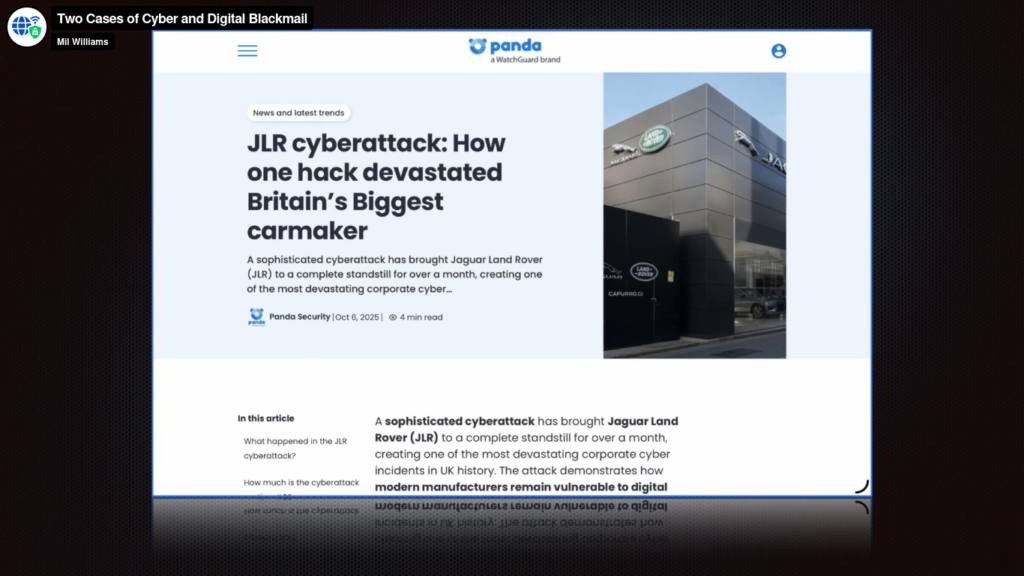
The second half of the video explains how we got here, but in a separate sense. Whilst the absence of real data to be able to point the finger in a way which would make things better all round is the focus of the first part, the second part shows the increasing impact of blackmail’s dynamics on getting access to information which would otherwise help stop such extreme criminality.
Because this is what a cybercrime fast morphing into a cyberwarfare is leading us all to: a criminality of the most extreme forms.
And at its heart is this reality: cyber and digital criminals are blackmailers, pure and simple. We don’t need new laws: we need the vigorous application of laws that were designed for some of the oldest crimes in the book. But in order to be able to do so as democracies and wider societies, we need to devolve how we protect the citizen so the citizen can in some legitimate and government-friendly ways protect themselves.
At Secrecy One Ltd, we want to help European, including UK, policing, security and counter-espionage to fight back across all levels of society, through such an approach.
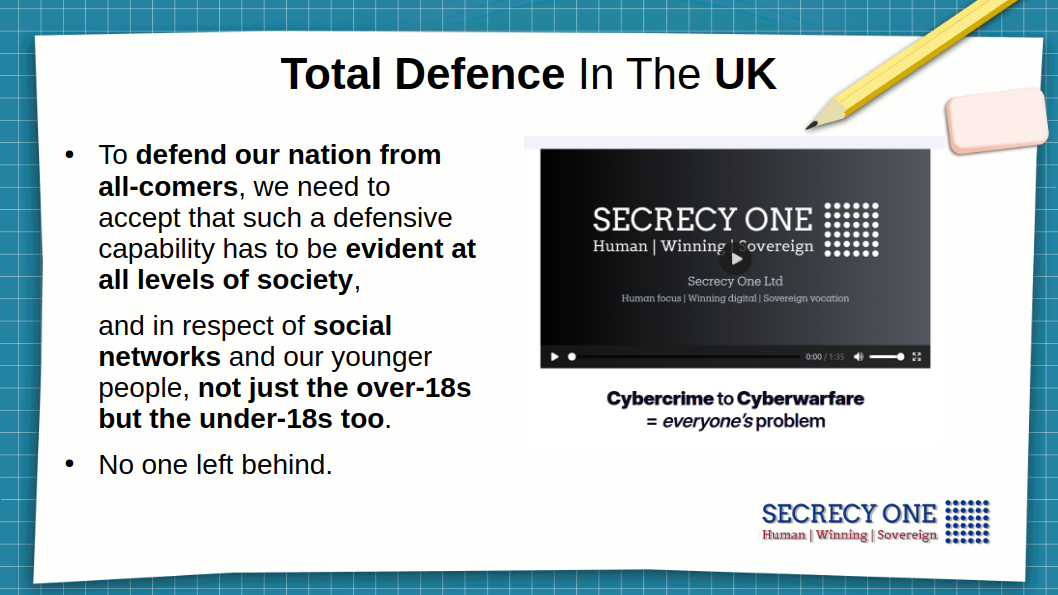
The first concept is a new security doctrine we’ve taken from Nordic, especially Swedish, praxis: it’s called Total Defence.
This is enshrined in our mission at the foot of this page: “Total defence: Building armed forces that fight battles and societies that fight wars.”
Click here for more.
With this, we want all citizens, whether professionals or not, to become far more aware of their digital and online surroundings. The state can’t do it all, but it can enable us all.
To deliver on this, we propose two applications:
- Verify Home | Click here and here | An app which makes it possible for citizens and SMEs to assess the safety of their digital and online surroundings, and then decide where to work, who to work with, and how to improve their own infrastructures.
- Verify Plus | Click here | An app which makes it possible for corporate bodies to begin to introduce new cyberwarfare-resisting architectures in cost-effective and planned ways, in order to protect their corporate assets from an increasingly penetrative and aggressive AI.
Finally, watch the video below to see how we could begin to implement the above.
Because where the landscape is blackmail in industrial quantities, surely it’s far better if, via a localised and properly regionalised set of total defence doctrines, duly adapted to UK security and policing doctrines and needs, we prevent these sorts of crimes before they happen, rather than continue to pay out and suffer after they take place.
After all, digital and online crime are massive cases of robbery and theft on the citizen — a digital mugging conducted by some nation-states, some corporations, and all individual criminal enterprises in equal parts.
A breath of fresh air, then, please, via the concept of Total Defence UK. A strategy to fight back in a cyber, digital, hybrid, and asymmetrical warfare currently being directed at all our citizens and livelihoods.